Skip to content

Smarth Jaswal

I build the interfaces AI products need but rarely have.

Screens to launch an agent run, watch it stream, and review what it produced before it ships.

  • Software engineer
  • 3 years in production
  • Gurugram, open to remote
Live surfaceSSE · 3 recorded runs

An agent run, end to end: launch, stream, inspect, sign off.

Pick a prompt and press Run. One of them fails on purpose — the error and retry path are part of the interface, not an afterthought.

Weekly ad-spend reviewAnalyst agent
idle0ms
example prompts

steps

No run yet. Pick a prompt and press Run.

tool calls

No tool calls yet.

output

Output streams here, token by token, over SSE.

Replaying a recorded run. The SSE transport, timings and failure handling are real; the content is fixed. Live mode available on request.

Work3 case studies

Three things I built, and what was actually hard about each.

Helix

Xneeti

AI operations platform

Agents that act on a seller's real revenue can't ship their output straight to the customer — but a review queue that slows every job to human speed defeats the point.

I own front-end delivery: the agent run surfaces for Analyst, Risk Manager and Creative Studio, SSE streaming that holds up across jobs measured in minutes, and a reusable role-config layer that routes AI-generated copy and images through four levels of sign-off. Also the Amazon SP-API and Ads OAuth integration, and the state architecture underneath — Zustand for client state, TanStack Query for server state.

  • Next.js
  • TypeScript
  • Zustand
  • TanStack Query
  • Tailwind
  • SSE

outcome

Agent surfaces ship against one shared sign-off layer instead of each growing its own review screen. A new agent arrives as a role config.

Seller accountSP-API · Ads OAuth
Run queuelong jobs · partial failure
Analyst
Risk Manager
Creative Studio

role-config sign-off layer

  1. L1 Operator
  2. L2 Risk
  3. L3 Brand owner
  4. L4 Account owner
Published to Amazononly after the chain clears
Architecture diagram, not a UI capture — Helix screens aren’t public. Every agent surface routes through the same configurable sign-off layer.

Lead Forge

AI lead enrichment platform

Enrichment runs bill per record, so an unbounded pipeline turns a prospecting list into an open invoice.

A NestJS and BullMQ pipeline on Redis that scrapes, enriches and scores Amazon seller data, with deduplication, stop conditions and per-job API cost tracking. Next.js dashboard streaming job progress over SSE. Structured leads land in PostgreSQL as JSONB; raw payloads stay in MongoDB Atlas.

  • Next.js
  • NestJS
  • PostgreSQL
  • MongoDB
  • Redis
  • BullMQ
  • OpenAI

outcome290,617 US leads

Dedup and stop conditions keep spend bounded, and every job reports its own API cost — so the bill is legible before a run, not after.

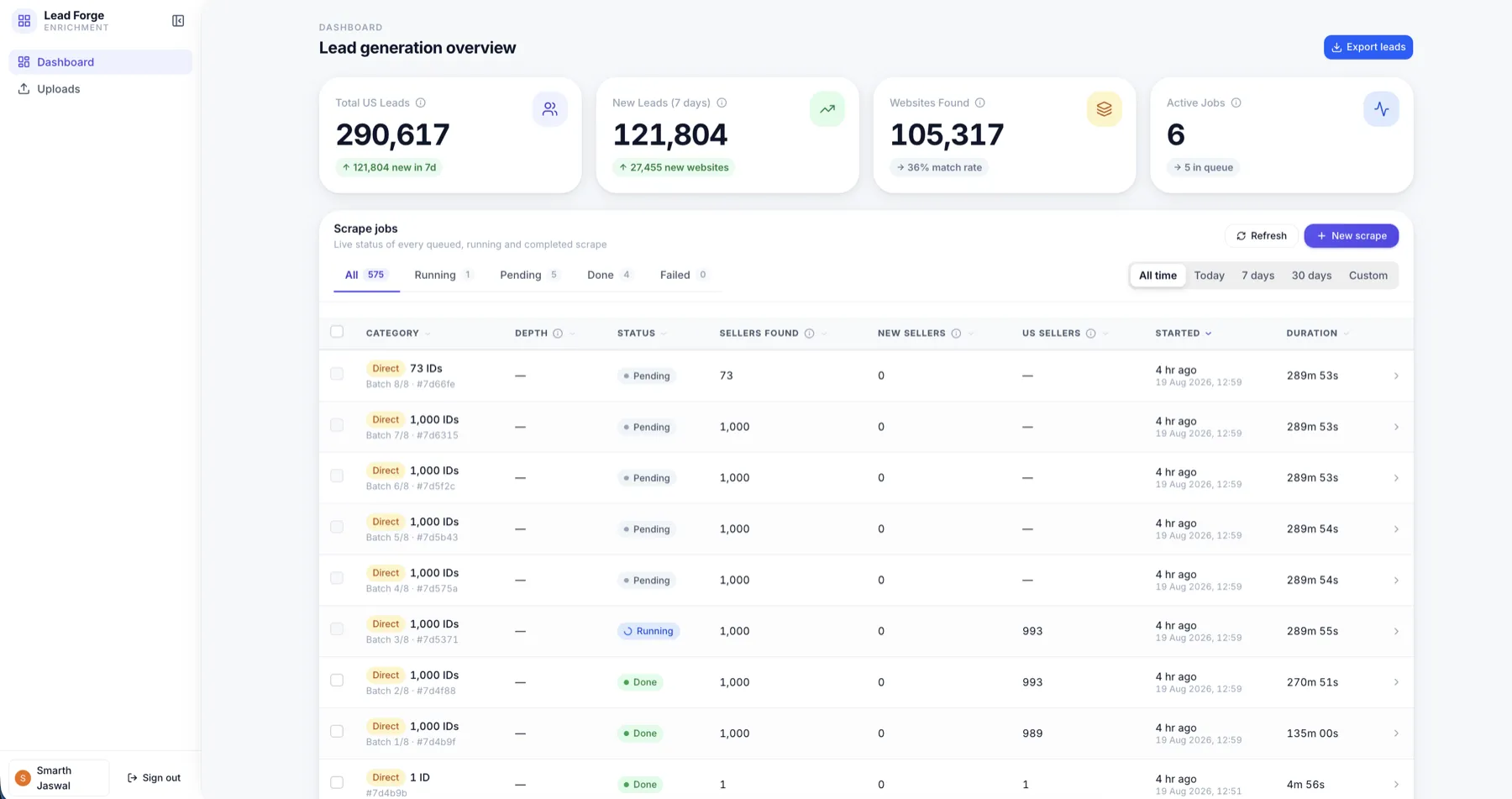
Lead Forge dashboard: 290,617 total US leads, 121,804 added in the last seven days, 105,317 websites found and six active jobs, above a table of 575 scrape jobs listing category, depth, status, sellers found, new sellers, US sellers, start time and duration for each.
Job list — every queued, running and completed scrape, with per-job counts and duration
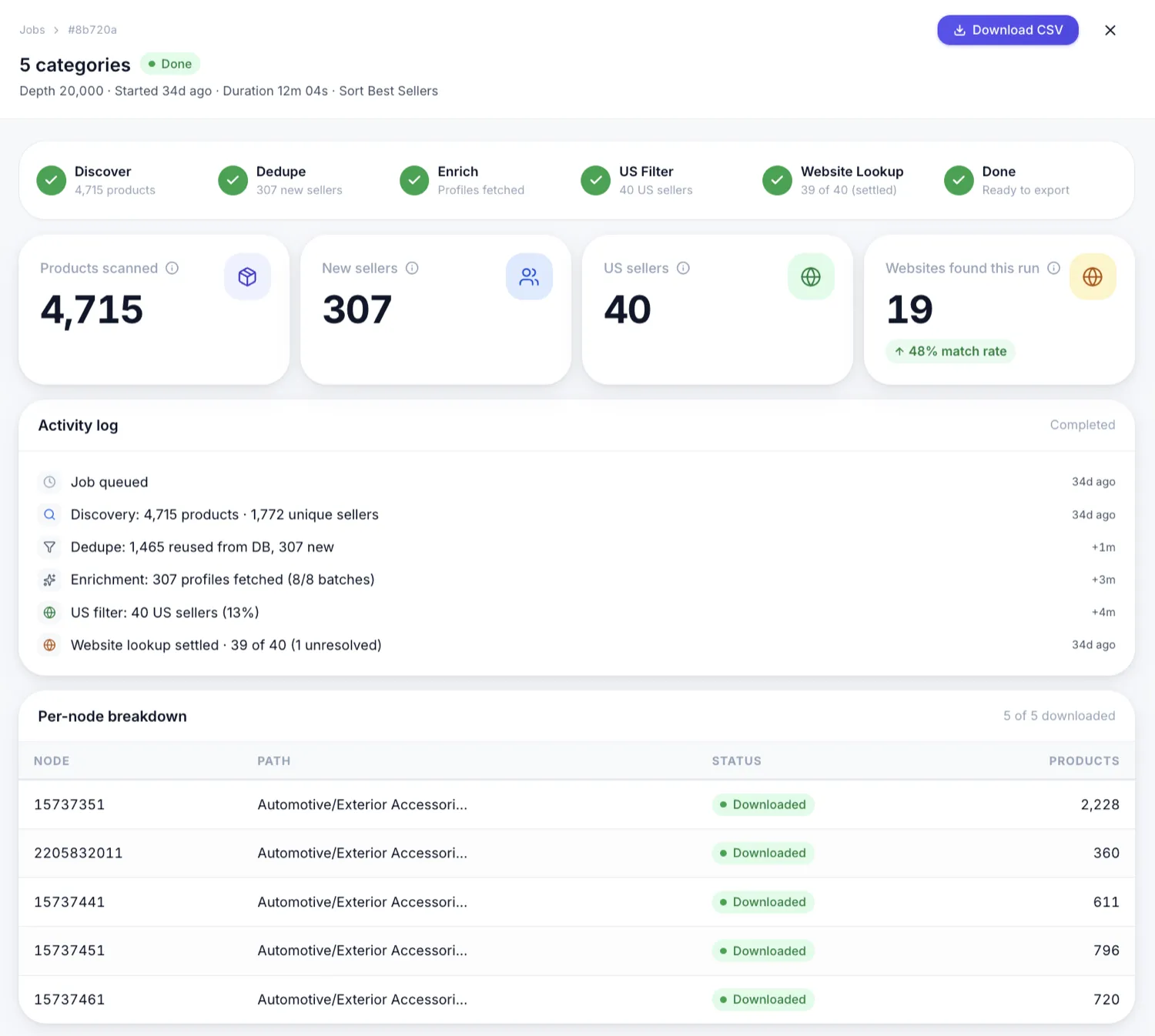
A completed Lead Forge job: a six-stage pipeline reading Discover, Dedupe, Enrich, US Filter, Website Lookup and Done, with 4,715 products scanned, 307 new sellers, 40 US sellers and 19 websites found at a 48 percent match rate, followed by a timestamped activity log and a per-node breakdown table.
One job opened up — stage-by-stage progress, activity log, and the per-node breakdown behind the totals

Notification-routing agent

HackerRank Orchestrate

24-hour hackathon build

Triage needs to know who is messaging and what came before — signal a message body alone doesn't carry.

An agent that sorts WhatsApp messages into notify, digest or mute, reading chat screenshots as multimodal input alongside CSV context for sender priority and history. Most of the work was in prompt structure, tuned specifically to cut false-notify cases.

  • TypeScript
  • Node
  • multimodal LLM prompting

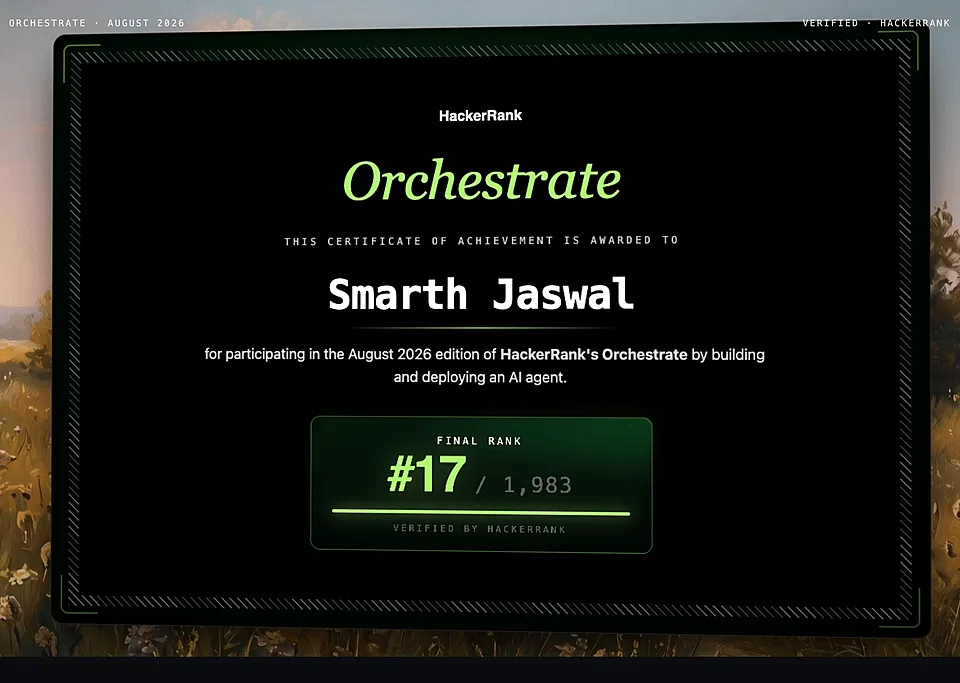
outcome#17 of 1,983 entries

Placed 17th of 1,983 entries — verified by HackerRank.

HackerRank Orchestrate certificate of achievement awarded to Smarth Jaswal for the August 2026 edition, showing a final rank of #17 of 1,983.
Verified by HackerRank · August 2026 edition
Skills

What I work with.

Languages

  • TypeScript
  • JavaScript (ES6+)
  • SQL
  • HTML5
  • CSS3

Frontend

  • React
  • Next.js (App Router)
  • Zustand
  • TanStack Query
  • Redux Toolkit
  • Tailwind
  • shadcn/ui

Backend

  • Node
  • NestJS
  • Express
  • REST
  • SSE
  • WebSockets

Data

  • PostgreSQL
  • MongoDB
  • Redis
  • BullMQ

Cloud

  • AWS (S3, EC2)
  • Azure
  • Docker
  • CI/CD
  • Terraform

AI

  • OpenAI and Claude APIs
  • prompt engineering
  • LangFuse
About

Short version.

Three years in production front-end, with enough back-end depth to own a feature end to end rather than hand it over at the API boundary. What I spend most of my time on now is the human side of autonomous systems: the surface that launches a run, the state that survives a long one, and the point where a person signs off.

I'm a founding engineer at Xneeti, where I own front-end delivery on Helix — a multi-agent platform running against live Amazon seller accounts. Jobs take minutes, fail halfway, and produce copy and images that somebody has to approve before a customer ever sees them. That constraint shapes every interface decision I make.

Before that, two years at Advantage Club building reusable React and TypeScript component libraries. That's where the unglamorous parts got learned — WCAG accessibility, test coverage with React Testing Library under TDD, and leading front-end code review.

Education

  • Post Graduate Diploma in Artificial Intelligence

    IIT Ropar · Aug 2024 – Aug 2025

  • B.Tech, Computer Science

    Rayat and Bahra University · 2015 – 2019

Contact

Hiring for a surface like the one above? Email me.

No form — a direct email gets a faster answer, and there's no backend here to maintain.